

New Delhi/Bengaluru: The Centre for Development of Telematics (C-DOT) has signed a tripartite agreement with the Indian Institute of Science (IISc), Bengaluru and the Foundation for Science Innovation and Development (FSID) to establish a Centre of Excellence (CoE) for advanced telecom research and innovation.
The Centre of Excellence aims to accelerate indigenous research, innovation, capacity building and commercialisation of next-generation communication technologies while fostering collaboration between academia and industry. The initiative is part of the Department of Telecommunications’ efforts to strengthen India’s self-reliance in critical telecom technologies.
The CoE will focus on wireless communications, artificial intelligence-driven communication systems, cybersecurity and quantum technologies, with advanced research in 5G Advanced, 6G, very large-scale MIMO systems, integrated sensing and communication, AI-native networks, and quantum and post-quantum communication technologies.
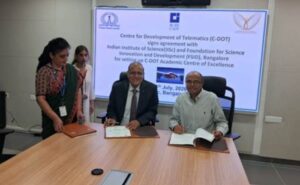
According to C-DOT, the collaboration combines IISc’s research expertise with the organisation’s experience in indigenous telecom development to accelerate innovation, generate intellectual property, support deep-tech start-ups and facilitate knowledge exchange through joint research, workshops and training programmes.
With the launch of the IISc facility, C-DOT has now established five Centres of Excellence, following similar collaborations with IIT Hyderabad, IIT Kanpur, IIT Gandhinagar and IIT Roorkee.
The agreement was signed in the presence of C-DOT Chief Executive Officer Dr. Rajkumar Upadhyay, FSID CEO Omprakash Subbarao, senior C-DOT officials and IISc faculty members. The event also marked the inauguration of the Centre of Excellence.
Addressing the gathering, Dr. Rajkumar Upadhyay said the collaboration would strengthen India’s capabilities in emerging technologies such as 6G, AI-enabled communication systems and quantum-secure communications, while contributing to the vision of a self-reliant and Viksit Bharat. Prof. Neelesh B. Mehta, Chair of the Department of Electrical Communication Engineering at IISc, said the partnership would promote long-term collaboration between researchers and industry experts to accelerate innovation in advanced communication technologies.
